

Games in the First Year of a Startup
Games in the First Year of a Startup
Couldn't load pickup availability
Please read the terms of service before purchasing. Your purchase signifies your agreement.
This product is a program where you can experience "business management" and "accounting" in a board game format.
Even those who have just joined a company or do not have specialized knowledge can learn accounting and management perspectives through the game.
Product Overview
The first-year entrepreneur game is a program where you can learn what company management is all about and what it means to manage from an accounting perspective, all in a board game format. You'll establish a company and, as a team, decide how to use limited resources (money, people, technology, equipment). You'll compete to see what social and economic value you can create, learning management principles along the way.
This program utilizes the following sheets, which correspond to the overall progress (some omitted).
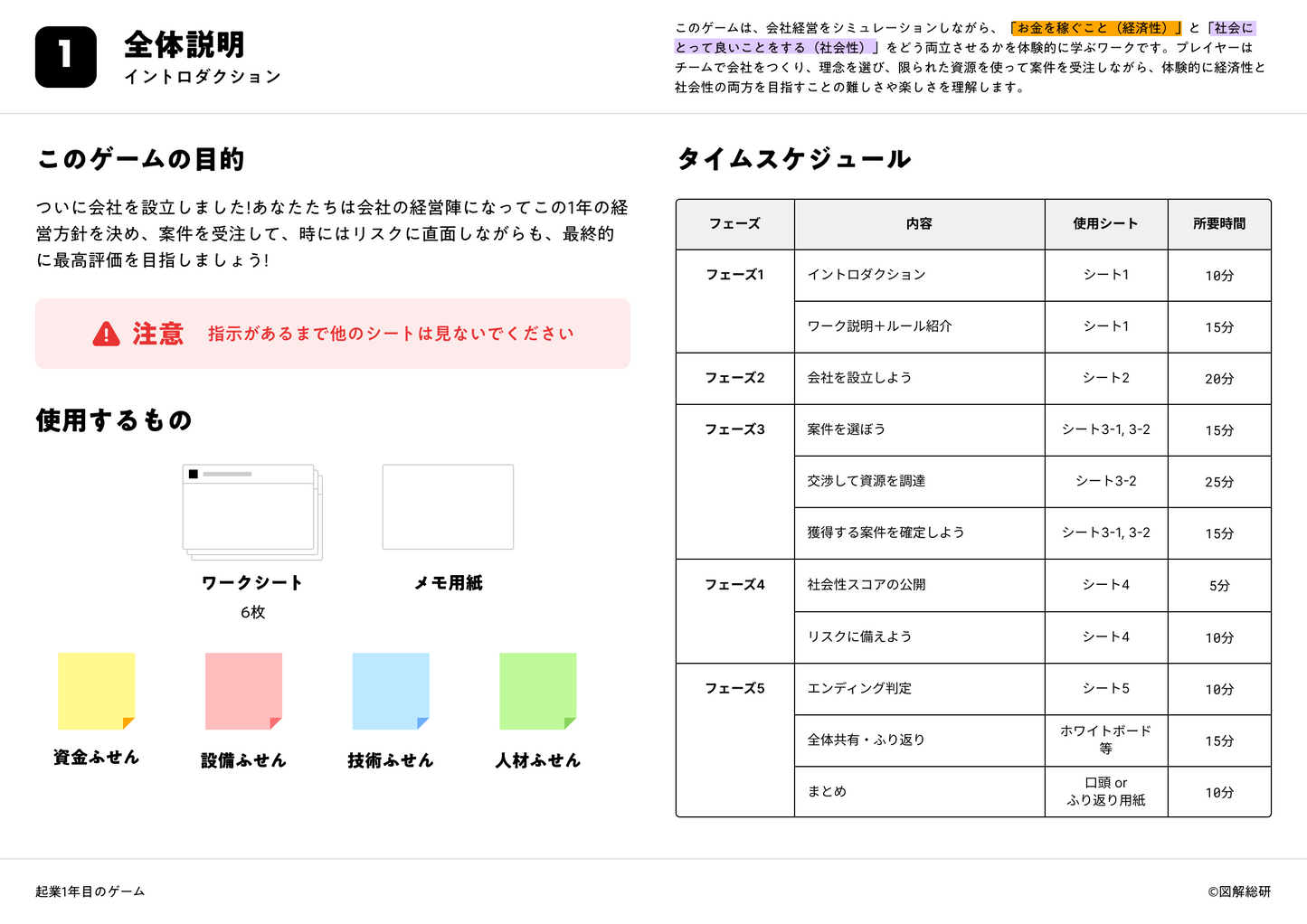
Sheet 1: Overall Explanation
This sheet describes the purpose of the program, materials used, and the timeline.

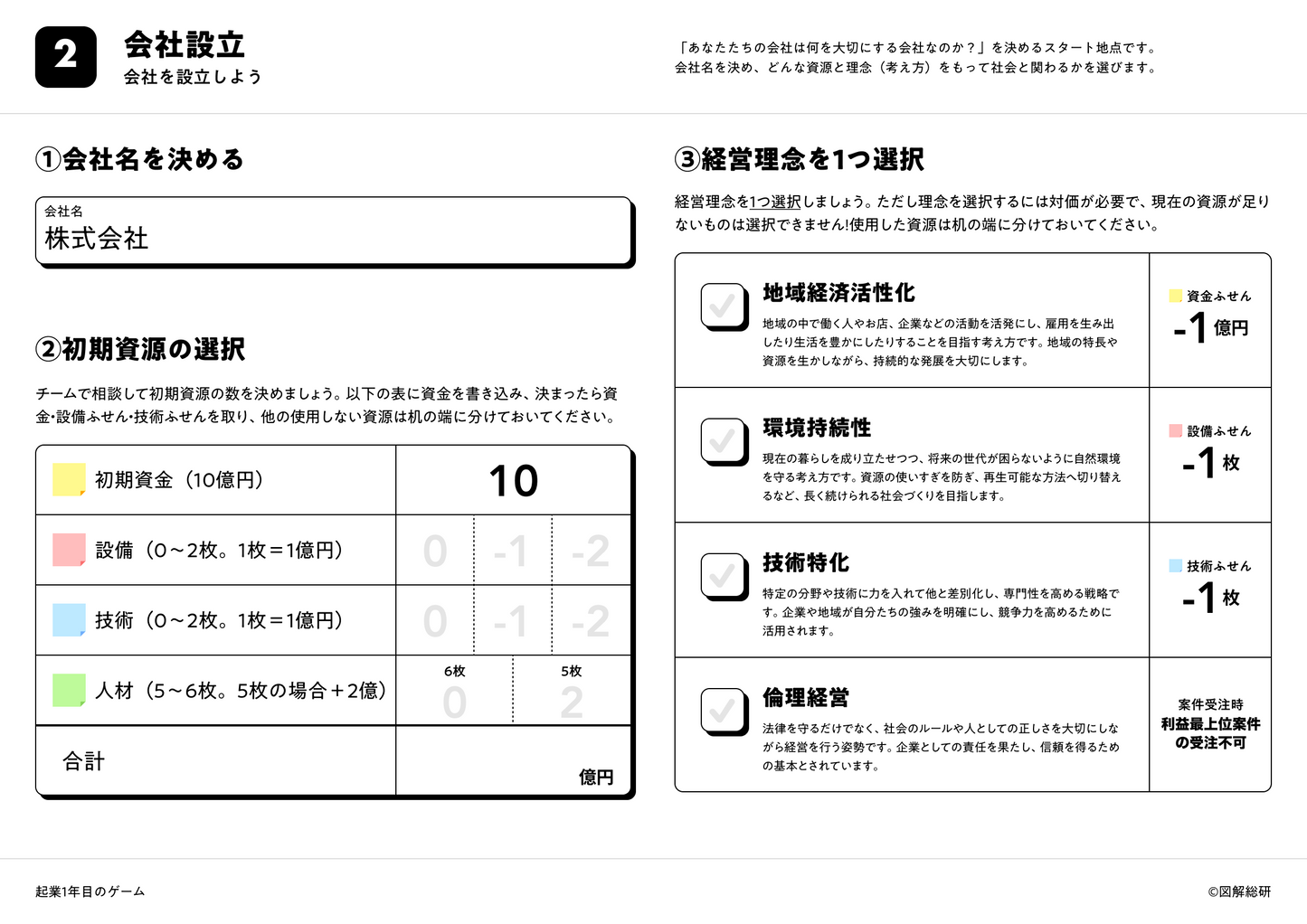
Sheet 2: Company Establishment
Enter your team name, corporate philosophy, and initial resource breakdown. This can also be used as an opportunity to discuss your overall company strategy and "what resource allocation would be best for this strategy?"

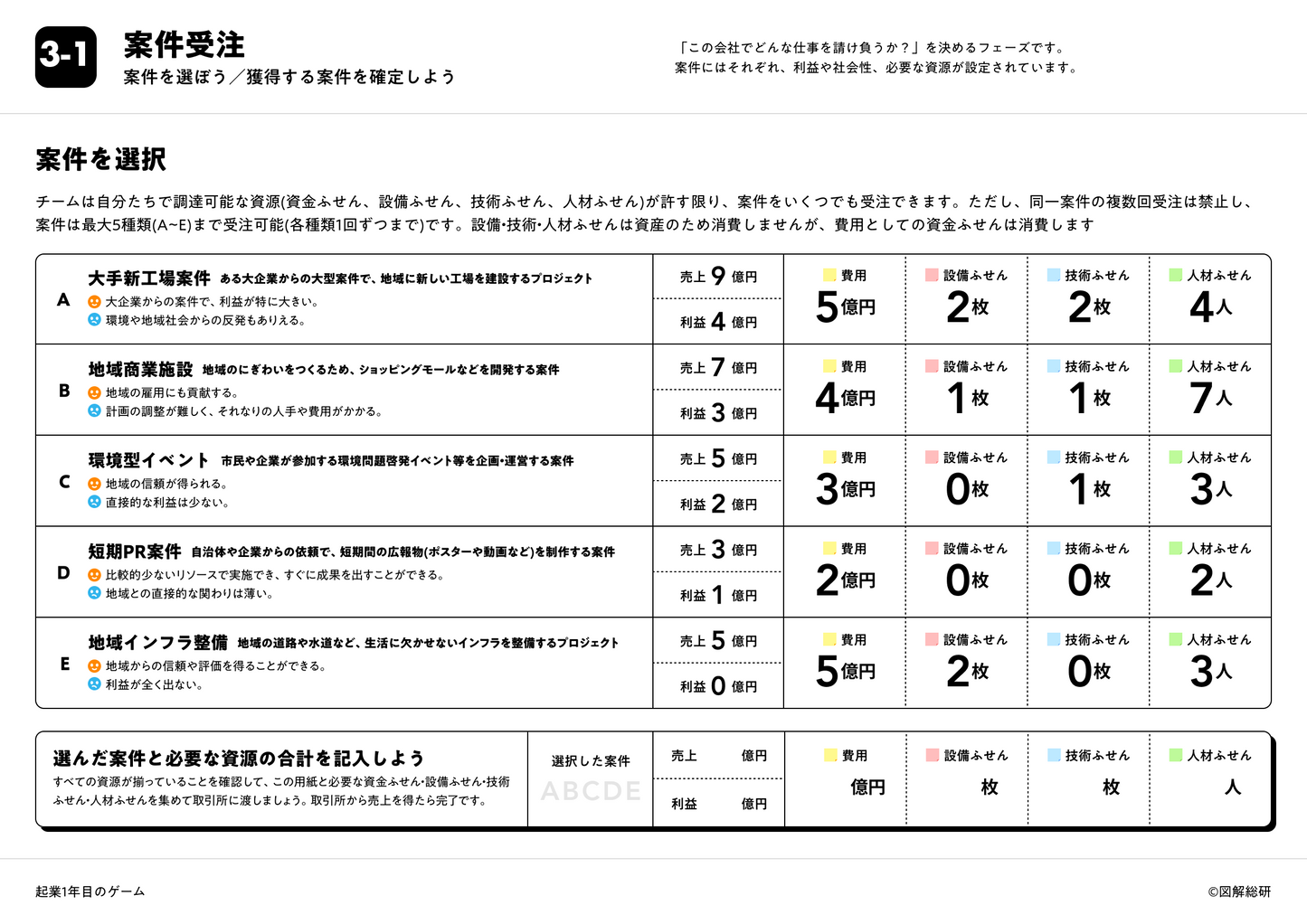
Sheet 3-1: Project Acquisition
A list of project types A to E is provided. Each project lists "Sales," "Required Resources," "Social Score," and "Profit (Sales - Costs)," which serve as decision-making factors. At the bottom of the sheet, record the selected projects, the sales and profits generated, and the number of remaining resource sticky notes.

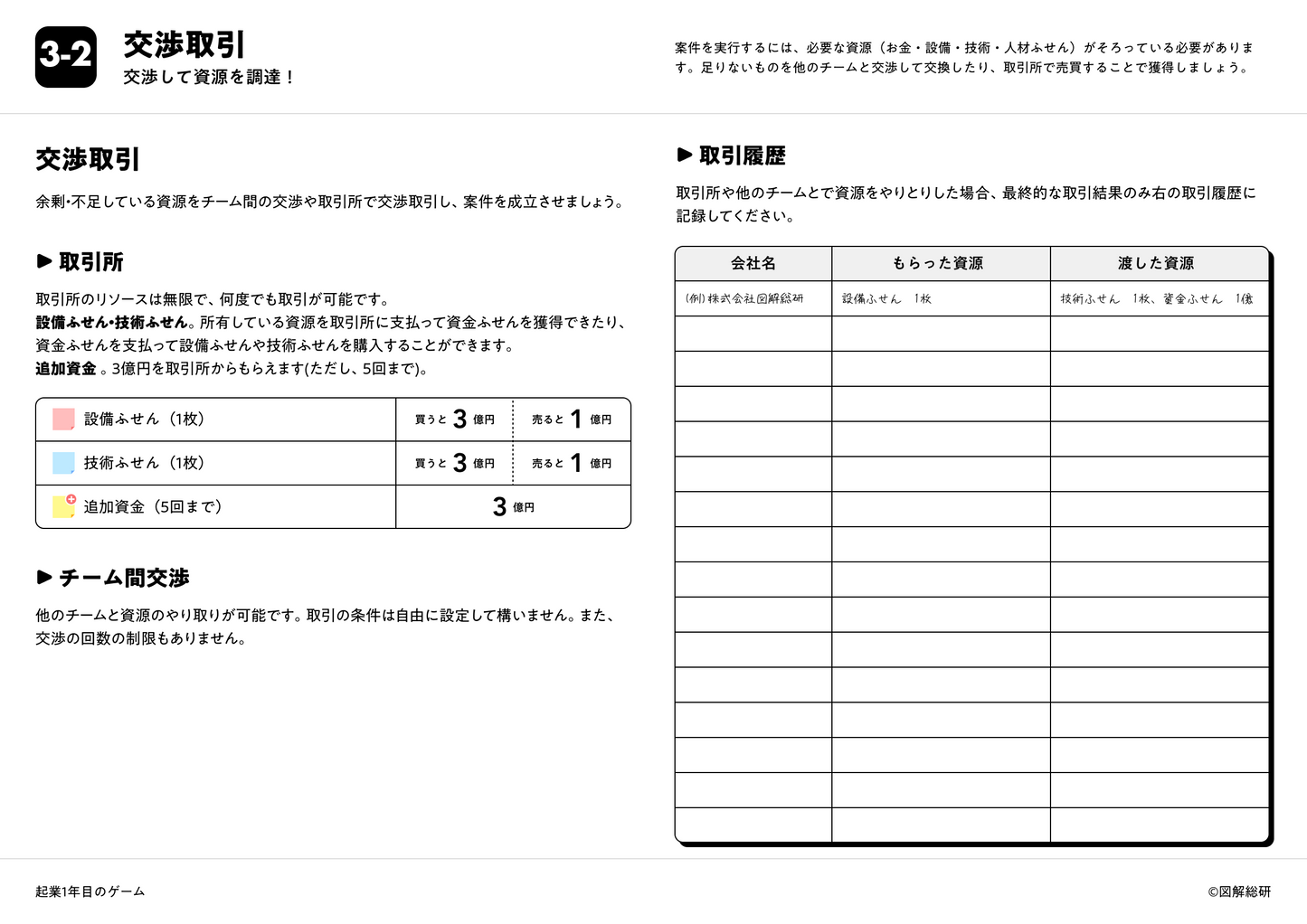
Sheet 3-2: Negotiation and Transaction
This sheet is used for negotiating resource sticky notes between teams. It records which sticky notes were exchanged and how. Ultimately, the resources remaining after these negotiations can be used to acquire projects.

Sheet 4: Social Score and Risk Encounter
This describes the risks likely to occur for each management philosophy and their potential impact.The impact of risks includes resource loss (e.g., money or equipment units) and a decrease in social score.
Sheet 5: Final Evaluation Sheet
This is a tallying sheet for calculating economic and social scores and determining the final evaluation rank (S to E).
The overall flow is as follows, with an estimated duration of 120 minutes.

The progression of each phase is as follows:
Phase 1: Introduction
Distribute Sheet 1 to each team, and the facilitator explains the program's objectives, purpose, and general flow of the day to everyone.
Phase 2: Establish a Company
- Distribute Sheet 2 to each team and have them decide on a team name (company name).
- Allocate initial resources (1 billion yen in funds) to equipment, technology, and human resources.
- Once the initial resource selection is made, provide the corresponding number of sticky notes from the exchange.
- Choose one management philosophy.
Phase 3-1: Select Projects
- Distribute Sheets 3-1 and 3-2 to each team.
- Choose a maximum of 5 projects (one of each type) from the 5 types of projects A to E.
- Review the "Sales," "Costs," and "Required Resources (equipment, technology, human resources)" for each project and decide which projects can be acquired based on your company's resources.
- Confirm the profit by subtracting costs from sales.
Phase 3-2: Negotiate and Procure Resources
Procure missing resources either by purchasing them from the "exchange" (fixed rate) or by negotiating freely with other teams.
Phase 3-3: Finalize Acquired Projects
- Check the resource sticky notes remaining after negotiations.
- Finalize the projects that can be acquired with those resource sticky notes.
- Record the finalized projects at the bottom of Sheet 3-1 and pay the generated costs and resources to the exchange with sticky notes.
- After paying the costs, count and record the sales, profit (sales - costs), and the number of various sticky notes obtained from the projects.
Phase 4-1: Social Score Disclosure
- Distribute Sheet 4 to each team.
- The social scores for the management philosophy chosen in Phase 2 and the projects acquired in Phase 3-3 will be revealed.
- Match your management philosophy with the acquired projects to calculate and record your company's total social score on the sheet.
Phase 4-2: Prepare for Risks
- Face random risks using the risk table (or risk cards).
- The type and impact of risks vary depending on the management philosophy.
- Resources are reduced or scores fluctuate according to the extent of the damage.
Phase 5: Ending Judgment
- Distribute Sheet 5 to each team.
- Convert each team's "resources" and "social score" into numerical values and tally the points.
- Determine the final evaluation (S to E) based on two axes: economic score and social score.
- Based on the evaluation rank, reflect on "what kind of company was ours?"
Detailed explanations of the flow and notes on progression are provided in the "First-Year Entrepreneur Game_Guidebook" included with this product purchase, so please refer to it.
Product Features
This program is based on the ideas from the book "Accounting Map: All About Cash Flow in Just One Diagram," and its purpose is to allow participants to experience and deeply consider the balance between earning money (economic viability) and doing good for society (social impact) from a management perspective.
In real-world management, "only pursuing profit" leads to a loss of social trust, while "only focusing on social contribution" makes the business unsustainable. In this game, the process of discussing and selecting projects as a team, managing resources, preparing for risks, and finally reflecting on the results, itself provides a simulated management experience.
Furthermore, by experiencing management-like decision-making through the game, it provides an opportunity to learn concepts like "management" and "accounting" which can otherwise feel distant. Since you can participate in the game without any specialized knowledge or experience, it can be widely used by anyone who wants to learn about accounting and management.
Related Products:
- First-Year Entrepreneur Game_Guidebook
- This is an instruction manual for those who will facilitate this program. It contains necessary preparations, flow, and precautions for actually conducting the program.
Recommended for:
- Those who want to train employees on accounting and management.
- Those belonging to companies or organizations that are working to balance social value and economic outcomes.
- Those considering team-building methods for projects or organizations.
- Those who want to create opportunities for dialogue across departments and positions.
Product Specifications
-
Product Format: Online Sale
-
Included Contents:
- Program Sheet (PDF format/7.71 MB)
- Facilitator Guideline (PDF format/2.59 MB)
-
Usage Period: Unlimited
-
Scope of Use: 1 license per individual/1 corporation
- Support: Inquiry response (email support)
Message from the Creator
The First-Year Entrepreneur Game is a program designed to make accounting and management feel more accessible.
"Money" is important and familiar in our work and daily lives. However, when it comes to perspectives like accounting and management, they suddenly acquire a difficult image.
Even if you try to study on your own, it's hard to maintain motivation without a clear idea of what you'll achieve after learning, or without experiencing how it would actually be used.
Therefore, we developed this program with the hope that by first experiencing management and accounting in a game-like way, people would come to feel that "management might be more interesting than I thought" or "re-evaluating decisions with numbers is quite fun."
We hope this experience serves as the "first step" for those considering learning about "management" and "accounting." We would be delighted if this time helps people realize that "my work is indeed connected to accounting."
Notes on Purchase
- Orders cannot be canceled due to customer convenience after payment is completed, and no refunds will be issued. Please be aware of this beforehand. Also, due to the nature of digital content, returns are not accepted under any circumstances. Instead of returns, issues will be handled as defects. In the event of a defect, such as a damaged content file making downloading or viewing impossible, we will cancel the charge after investigation. Defects due to the customer's unique environment are not eligible for returns.
- If you wish to pay by invoice, please contact us via inquiry to that effect.
- Receipts are issued automatically. If you need one, please click "Print Receipt" on the screen displayed after purchase or in the email sent after purchase.