
ABOUT
About ZUKAI
ZUKAI helps create an environment where diverse stakeholders can share their intentions, by visualizing complex information and concepts through diagrams. The way people perceive things differs from person to person. Diagrams work as an infrastructure that aligns people’s perceptions and lets them communicate on equal terms. When diagrams are present in various scenes of communication, they help align the views and feelings of those gathered there, and move things forward.
PURPOSE
Bringing people and society closer together through diagrams
At ZUKAI, we use diagrams as a tool to create an environment where people can deliver their own voice to society. Today, with environmental change driven by technology, the spread of new values, and shifts in the international situation, the issues society faces are growing more complex. To grasp and act on these conditions, discourse unfolds daily, new concepts and ideas are born, and information circulates. Yet those concepts and ideas are not always in a form that is easy for everyone to understand. The learning cost of grasping difficult concepts, and the communication cost of accurately understanding one another, become enormous. The burden this places on each individual is far too great. When people face this cost head-on, many feel “this seems somehow difficult” and avoid confronting the issue. As they keep avoiding it, that sense of difficulty grows over time. People find it hard to voice opinions about things they don’t understand. As a result, they become unable to see society as their own concern, and society gradually feels like a distant entity. Meanwhile, only those who can pay that cost—those with the margin to do so—can get close to society. Only a portion of people who hold that information can understand the state of society and reflect their opinions onto it. When people try to communicate in this state, power relationships arise. Depending on the presence or absence of knowledge, one voice becomes weak and another becomes strong. This is unhealthy communication. What this unhealthiness signifies is an imbalance of power. In other words, those who can feel a real sense of moving society directly—those who are close to society—are limited to a powerful few. So at ZUKAI, by creating diagrams as a communication tool, we want to overcome this unhealthy situation. As a “common language,” our diagrams open up complex information to more people, and give them the power to make it their own, use it, and share it with others. By inventing diagrams as a “common language” and making them a foundation of society, we create a situation where more people can take part in society as their own concern—bringing people and society closer together.
MISSION
Inventing common languages
ZUKAI invents diagrams as a “common language” by collaborating with experts. Experts at companies, research institutions, governments, and elsewhere share their expertise (specialized information) with us, and we structure that information into diagrams that are easier for more people to understand and convey.
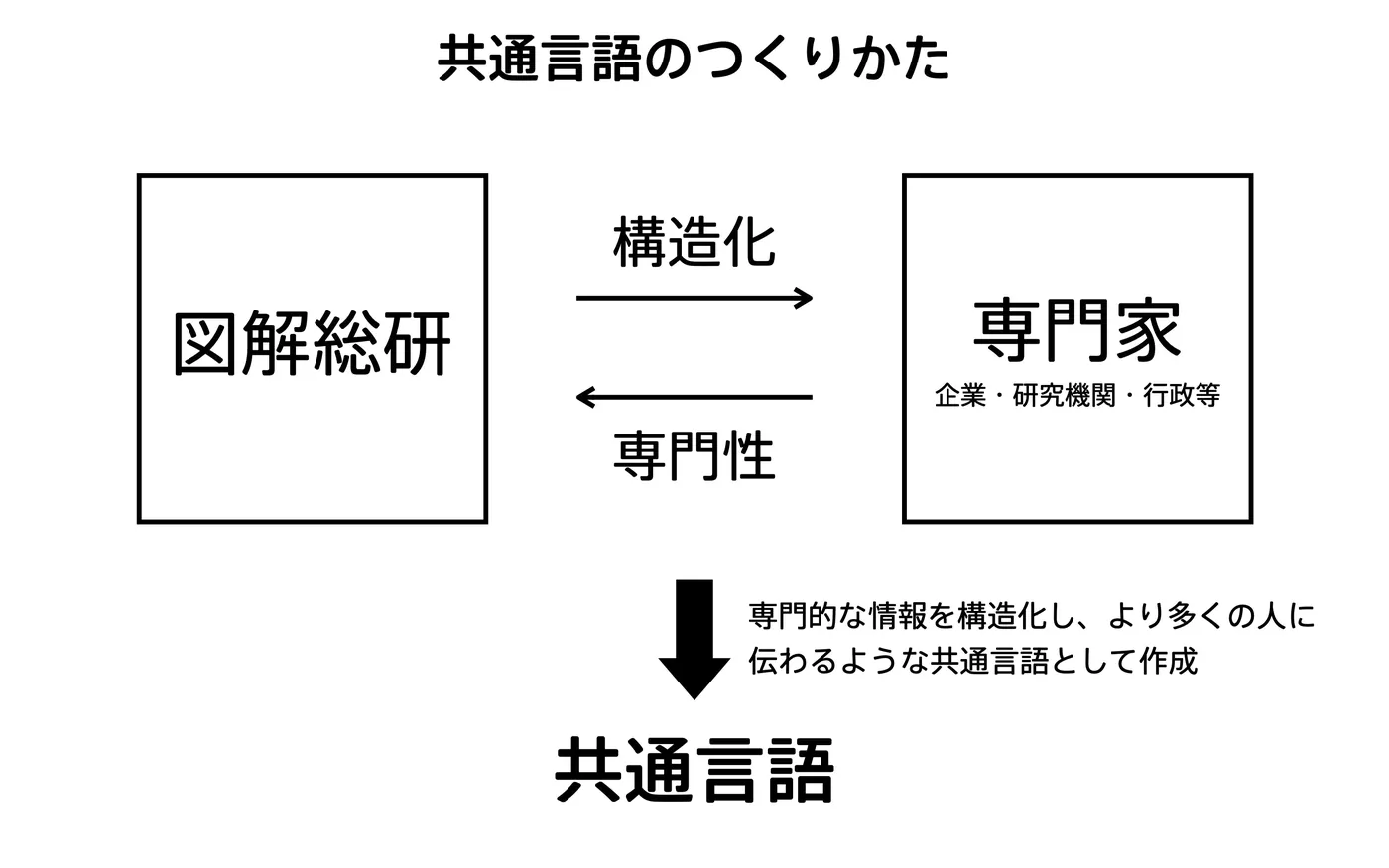
A diagram as a “common language” is a tool that organizes and structures information about a particular theme (a concept, a social issue, and so on) using a shared format—lowering the barrier to understanding while reducing the cost of communicating with others. What one person is thinking is invisible to others. That is exactly why what we want to convey often fails to get across, and discussions turn into crossed wires. By having a tool—a diagram—that “visualizes the inside of your head clearly for the outside so the same understanding can be shared,” we lower the communication cost of accurately understanding one another. Our diagrams organize and structure information into a shared format. As long as you grasp the rules, then regardless of differences in prior understanding of the subject, you can share literacy with others through the diagram and align differences in perception during communication. In other words, diagrams function as a communication tool. For example, when you think “let’s consider the business model of a business idea,” if there is no shared understanding of what a business model even is, or what counts as “thinking about a business model,” the members cannot even hold a discussion. Not all members necessarily possess that knowledge, and it is unclear whether they hold the same amount of it. So you first have to start by aligning understanding. In this way, gaps in the premise of talking about the contents of a “business model” generate large communication costs. In some cases, there may also be people learning about a concept like a business model for the first time and having to study it from scratch. The learning cost of studying an unfamiliar concept before joining a discussion is a major cost for the team, and above all for the person themselves. But what if there were a diagram? One of our diagrams is the “business model diagram.”
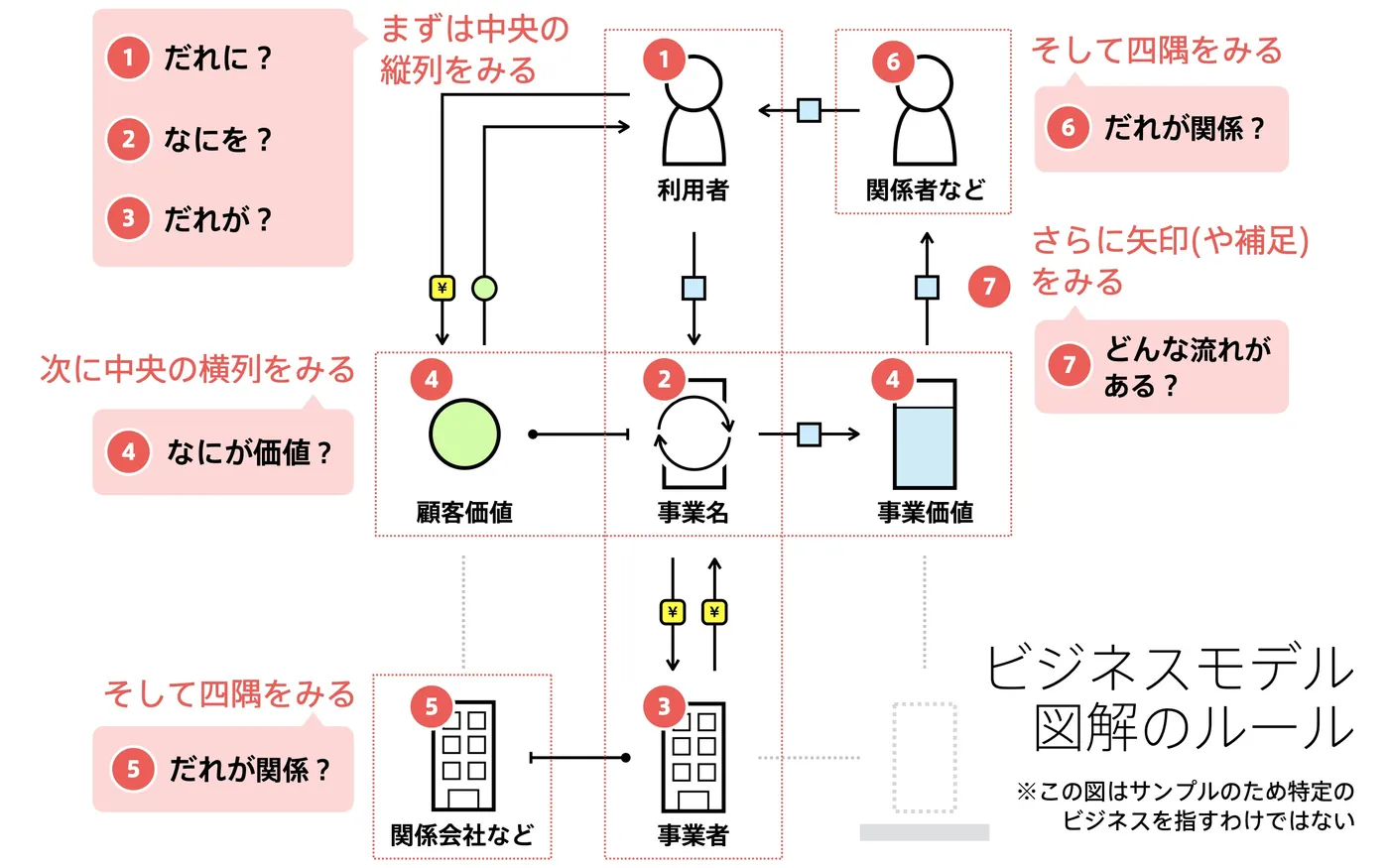
This “business model diagram” defines a business model and the rules for reading it. It also includes a toolkit for actually building a business model yourself. If these tools and rules are shared with a team, the team’s perception of how to view and think about a business model gets aligned. And by understanding the rules and using the toolkit, you can convey your own business-model idea to members in a form they can grasp. In this way, when the foundation of diagrams is shared within a team, it reduces the learning cost of business models, reduces the communication cost of aligning gaps in understanding, and creates an environment where every team member can assert their own opinion on equal footing. The business model is merely one example. With diagrams as a shared format, you can build a foundation for equal dialogue across various themes—curbing the power that comes from the presence or absence of knowledge. The rules of diagrams dissolve the imbalance of power and pave a path for participating in discussion. In other words, diagrams become a common language for people and help them regain their voice.
MORE INFORMATION
Learn more here
We offer various programs that make use of the common languages and diagram methods developed by ZUKAI. To learn more, please see the details of our business.
If you would like to learn more about the common languages ZUKAI has developed so far, please see the details of each common language.