Keeping Social, Business and Creative in balance
Our values are Social, Business and Creative, or SBC for short.
Why do Social, Business and Creative matter?
Work that lacks any one of Social, Business or Creative ends up sacrificing someone, running out before it can last, or changing nothing.
We judge our own work by whether Social, Business and Creative are in balance. The order to think in is Social, Business, Creative. That is because chasing Business or Creative with Social put off can end up sacrificing someone. Creative work with neither Social nor Business behind it is merely new, and of use to no one. We call the three SBC, after their initials, and they are the first thing we return to when we look back on our work.
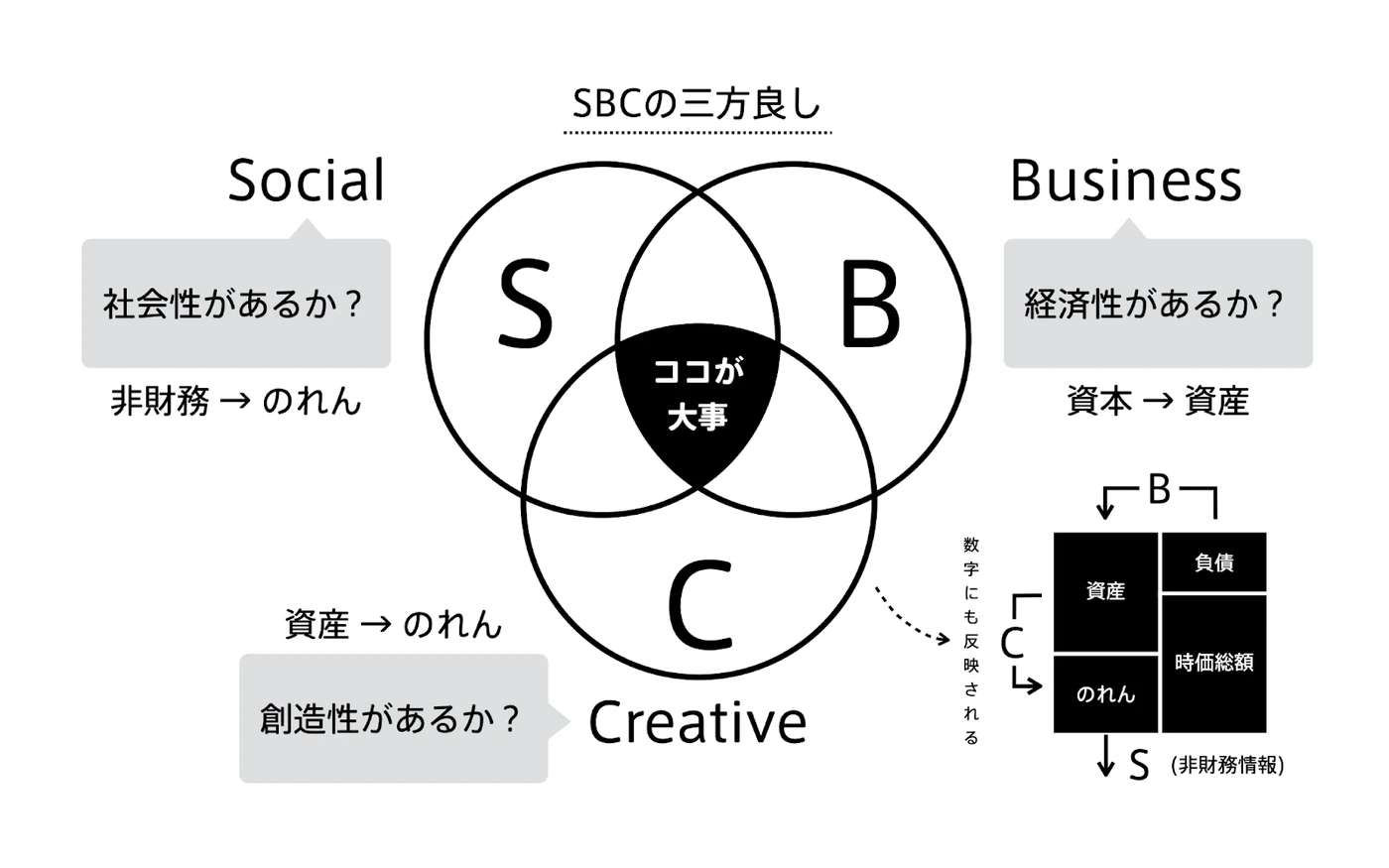
We define each of them as follows.
Social
Social means asking who and what our work is for, and what effect it has on society. We aim for work that brings a positive impact to the stakeholders involved. That thinking led us to co-develop the Purpose Model in 2020: a model that puts a shared purpose at the center and makes visible who is involved and how. We also use it to lay out everyone involved in a project on one page and check whether anyone has been left out, or asked to bear the cost.
More on the Purpose Model →Business
Business means whether the work is economically viable. However much social meaning it carries, it cannot last unless it pays its way. As a way to think about this, we devised Bizgram in 2018: a framework that lays out the elements essential to a business model on a 3×3 grid. With Bizgram, a business model that is hard to put into words can be shown clearly and concisely, and it takes less effort to explain.
More on Bizgram →Creative
Creative means finding what is new in an idea by asking which part of the industry’s received wisdom it overturns. We set out how to read that in Business Model 2.0 Visual Guide (2018), calling it the structure of paradox: we decide what the business offers (the starting point), read the industry’s received wisdom from it, find what the idea overturns, and finally combine that with the starting point, in that order. The stronger the paradox, the further it departs from the industry’s common sense, and the more it needs a mechanism of its own to work as a business. Over time, even a paradox that was once new becomes received wisdom, and new paradoxes emerge from it. So what counts as a paradox has to be questioned again and again.
Read about Business Model 2.0 Visual Guide →Contact
A problem you are stuck on, a project you are considering, a press inquiry. We also take inquiries that have not taken shape yet.
Talk to us