
Purpose Model
A blueprint for co-creation that organizes the shared purpose and roles of multiple stakeholders.
What is the Purpose Model?
The Purpose Model is a “blueprint for purpose-centered co-creation projects” that lets diverse stakeholders act together. With the project's purpose (shared goal) at the center, the related stakeholders are arranged around it, visualizing who participates in the project, in what role, and for what reason. Using the Purpose Model, in projects that aim to create social value rather than just profit, you can put the purpose into words in order to share it with others, and check whether the stakeholders who have gathered are heading in the same direction.
How the Purpose Model works
What is the Purpose Model?
Purpose Model
A tool for showing who takes part, for what purpose and in what way, around a shared purpose at the centre.
How to read it
The model is split into top and bottom
The bottom half is for active co-creation partners: stakeholders who act on their own toward the shared purpose. There are three conditions: they support the shared purpose, they provide resources, and they take initiative. Examples are the organisation driving the project, partners who share the same concern, and users who contribute to the project.
The top half is for stakeholders involved in co-creation, such as people who use the place, users of an app or service, client companies, and others who take part by paying.
What to write
Start with stakeholders on the outside
Write the name of each stakeholder in the outermost ring. It can be an organisation, or a group with the same role, such as local residents or the users of an app.
Stakeholder here does not only mean someone with a financial interest. It means any person or organisation involved in the business or project.
What to write
Colour-coding stakeholders
Stakeholders are sorted into four groups, companies, government, citizens, and universities, research bodies and experts, each with its own colour. Associations and non-profits are usually shown in purple, with the experts, because of their expertise. A foundation's colour depends on where its funding comes from.
Companies As private businesses, they provide resources such as money, space and technology Government As public bodies, they take part through laws and systems, such as policy design, budgets and tax incentives Citizens As residents and users, they consume and take part Universities, research bodies, experts As researchers and experts, they provide academic knowledge What to write
Inside each stakeholder, their role
Write the role each stakeholder plays to make the project work, for example paying, giving feedback, or planning.
What to write
Further inside, each stakeholder's purpose
Write each stakeholder's purpose: their motive or reason for taking part, for example to widen their network, to use the service, or to put their knowledge to use. Phrasing each one as "wants to …" keeps them consistent.
What to write
In the centre, a title and the shared purpose every stakeholder supports
The shared purpose puts the project's purpose, which all stakeholders share, into concrete words. People in different positions should be able to make it their own.
Rule
Each area's name, role and purpose connect to the shared purpose in the centre
If you cut out one stakeholder's block, its name, role and purpose all point toward the shared purpose in the middle, and each block takes its place in the circle.
Who uses it
- planners and secretariats of co-creation projects run by several organisations
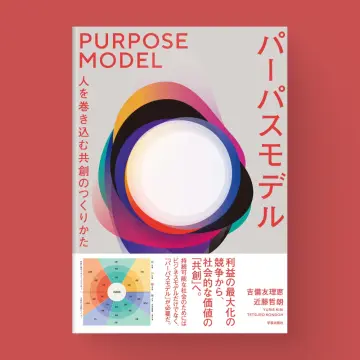
It became the book "Purpose Model" in 2022. It has also been the subject of a workshop at SAAI in Yurakucho and an event held by the Business Model Association of Japan.
Use it as an app
Purpose Model StudioDraw purpose models on the spot
Purpose Model Studio is a web tool for editing purpose models. Place stakeholders and their roles around a shared purpose to build the blueprint for a co-creation project on the spot. It was recently overhauled—now with mobile support, wider browser compatibility, JSON import/export, higher-resolution screens, and improved usability.
Try Purpose Model Studio ↗Get the toolkit

パーパスモデルツールキット(スライド)From ¥1,650
A printed and slide set of the Purpose Model, ready to use in a workshop. Sold in our shop.
See it in the shop ↗Read the book
Using a tool called the “Purpose Model,” this book analyzes co-creation project cases from Japan and abroad while explaining the ideas and methods of co-creation. The Purpose Model is a “blueprint for purpose-centered co-creation projects” that lets diverse stakeholders act together. Looking at projects in a shared format with purpose at the center, it answers questions about co-creation in a practical way.
How the Purpose Model Was Born
The Purpose Model is a tool for visualizing “co-creation.”
Some may not be used to the word “co-creation,” but it means exactly what the characters say: creating together. Put more plainly, we think of co-creation as “people combining different perspectives to create new value.”
In the present day, various social issues appear simultaneously, intertwine in complex ways, and it is becoming harder and harder for any single person to solve them.
In such times, people of different attributes—companies, governments, citizens, experts—need to act together while making the most of each other's strengths. Multilayered perspectives, not a single viewpoint, are increasingly required.
As one such common language, we created the Purpose Model as a framework for visualizing co-creation.
Even for completely different initiatives, looking at them through the shared format of the Purpose Model makes it easier to survey the whole picture of for what, by whom, and how people participate.
Furthermore, in business settings there have not been many opportunities to convey one's true feelings or share one's real thoughts; there were more than a few situations where appearances came first and talks proceeded on that basis.
But in the era to come, I think it will increasingly be individuals' passionate feelings—and the strong driving force that comes from them—that move everyone's hearts and create the world as it should be. I believe the Purpose Model can also be used as a tool to encourage this sharing of feelings.
News about this framework
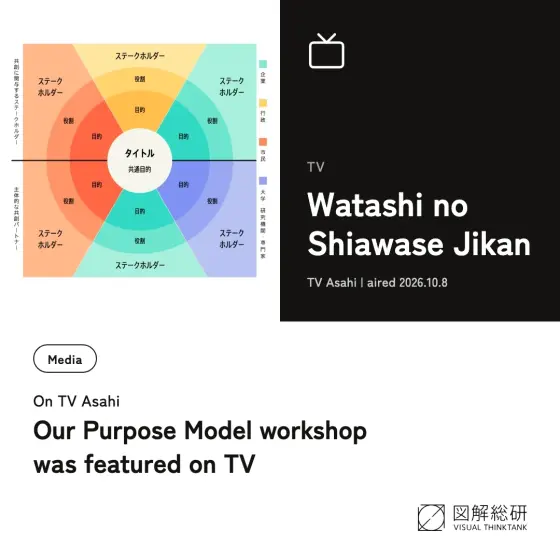 A workshop using the Purpose Model was shown on TV Asahi's "Watashi no Shiawase Jikan"News2026/10/08
 The full text of Purpose Model is now free to read on noteNews2026/10/05
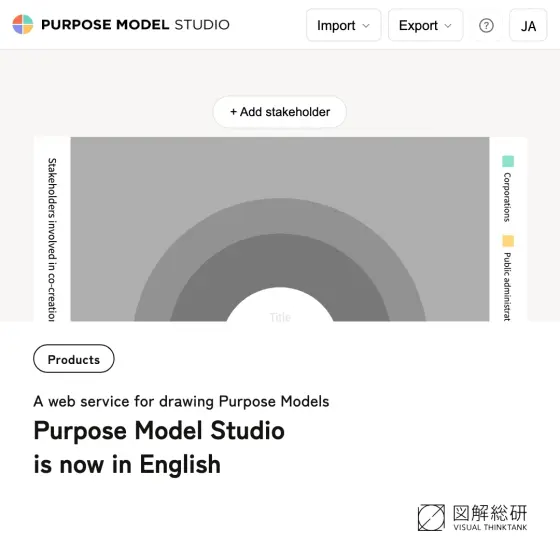 Purpose Model Studio is now available in EnglishNews2026/07/21
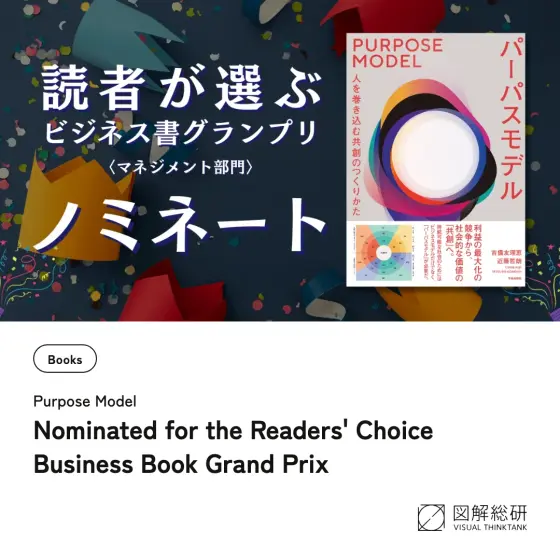 Purpose Model nominated for the Readers' Choice Business Book Grand PrixNews2022/12/19
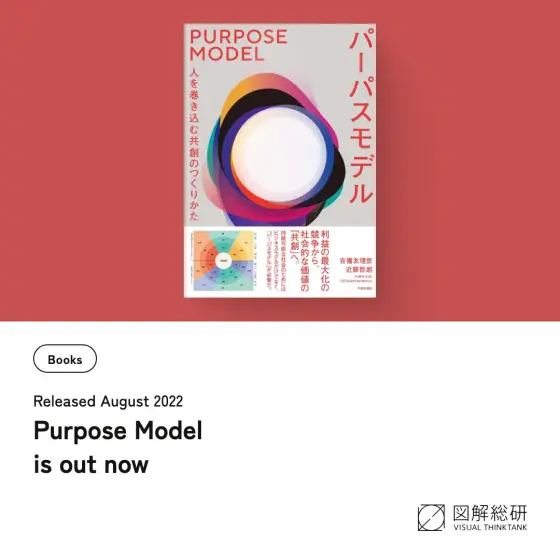 Purpose Model: How to Build Co-Creation That Engages People is out nowNews2022/08/10
 We've released Purpose Model Studio, a tool for drawing Purpose ModelsNews2022/08/09
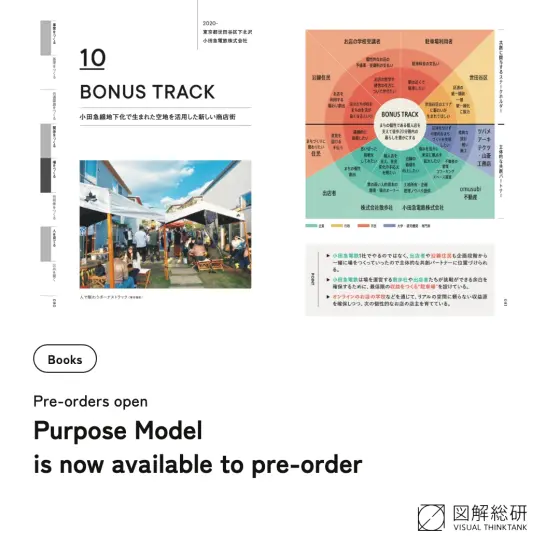 Pre-orders open for Purpose ModelNews2022/07/19
Contact
A problem you are stuck on, a project you are considering, a press inquiry. We also take inquiries that have not taken shape yet.
Talk to us