
Strategy Map
A map that gives an overview of the frequently used frameworks—from corporate strategy to business models—and how they relate.
What is the Strategy Map?
The Strategy Map gives an overview of the sequence of 11 management strategies and frameworks that are useful to consider when a company creates a business—flowing all the way from corporate strategy down to the business model. Because it also includes the “questions” for thinking through strategy, it clarifies which frameworks you should be considering and makes it easier to build a strategy. Using the Strategy Map, you can fill in missing perspectives—such as grasping where you currently stand or identifying a business's bottlenecks—when creating new businesses or analyzing existing ones.
How the Strategy Map works
What is the Strategy Map?
Strategy Map
An overview diagram of the frameworks that come up most often when building a business strategy, from corporate strategy to business models, and how they relate. It covers 11 frameworks.
The map has two areas. The centre holds a diagram that breaks strategy down into a structure. The outer area explains the frameworks related to strategy.
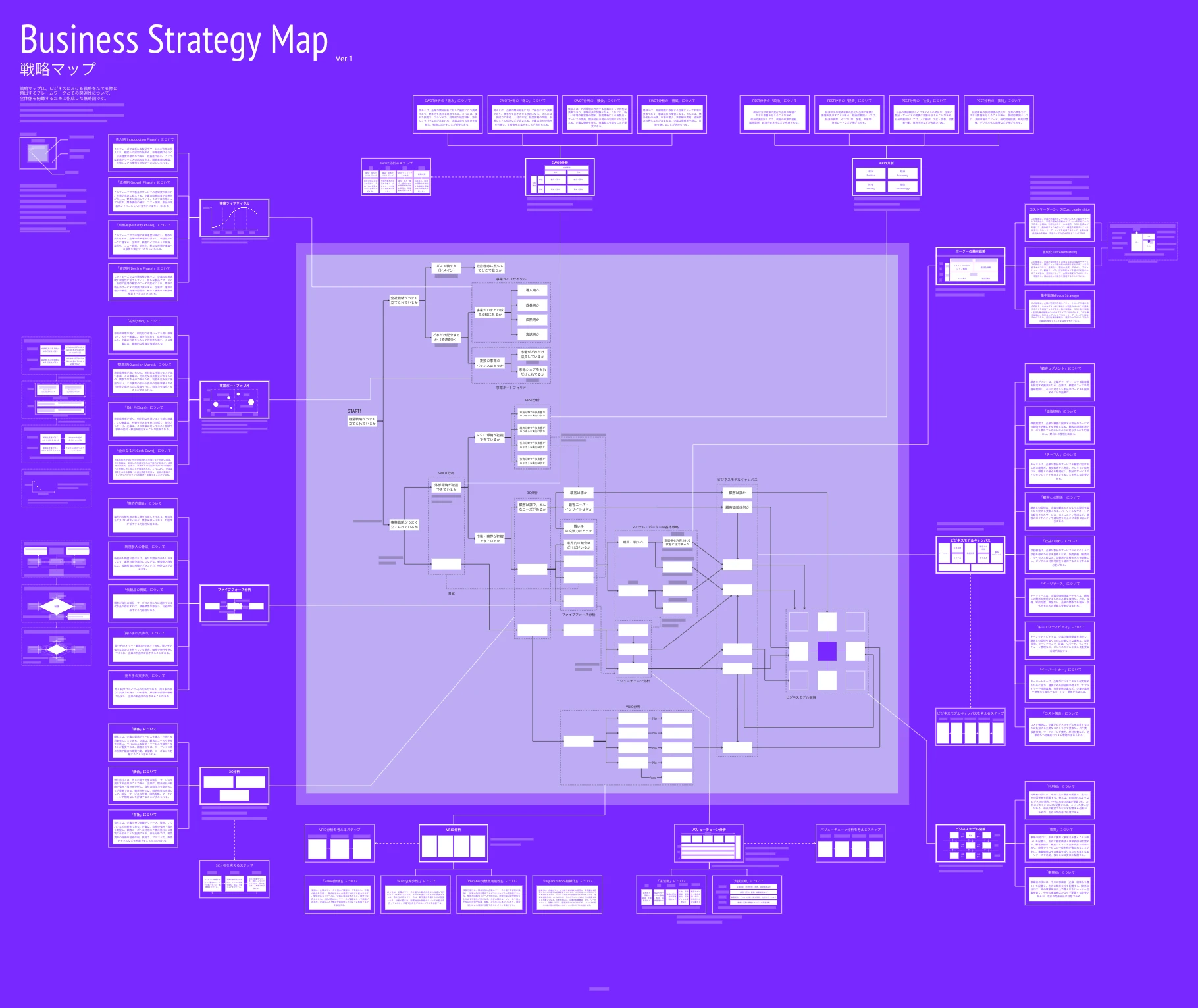
What is the Strategy Map?
Frameworks
The frameworks in the Strategy Map were chosen for what is needed to see how everything connects.
The 11 frameworks covered in the Strategy Map
Corporate strategy
- Business life cycle
- Business portfolio
Business strategy
- SWOT analysis
- 3C analysis
- Porter's generic strategies
External analysis
- PEST analysis
- Five forces analysis
Internal analysis
- Value chain analysis
- VRIO analysis
Business model
- Business Model Canvas
- Bizgram
How to read it
Start from the question on the left of the centre: is the management strategy well built?
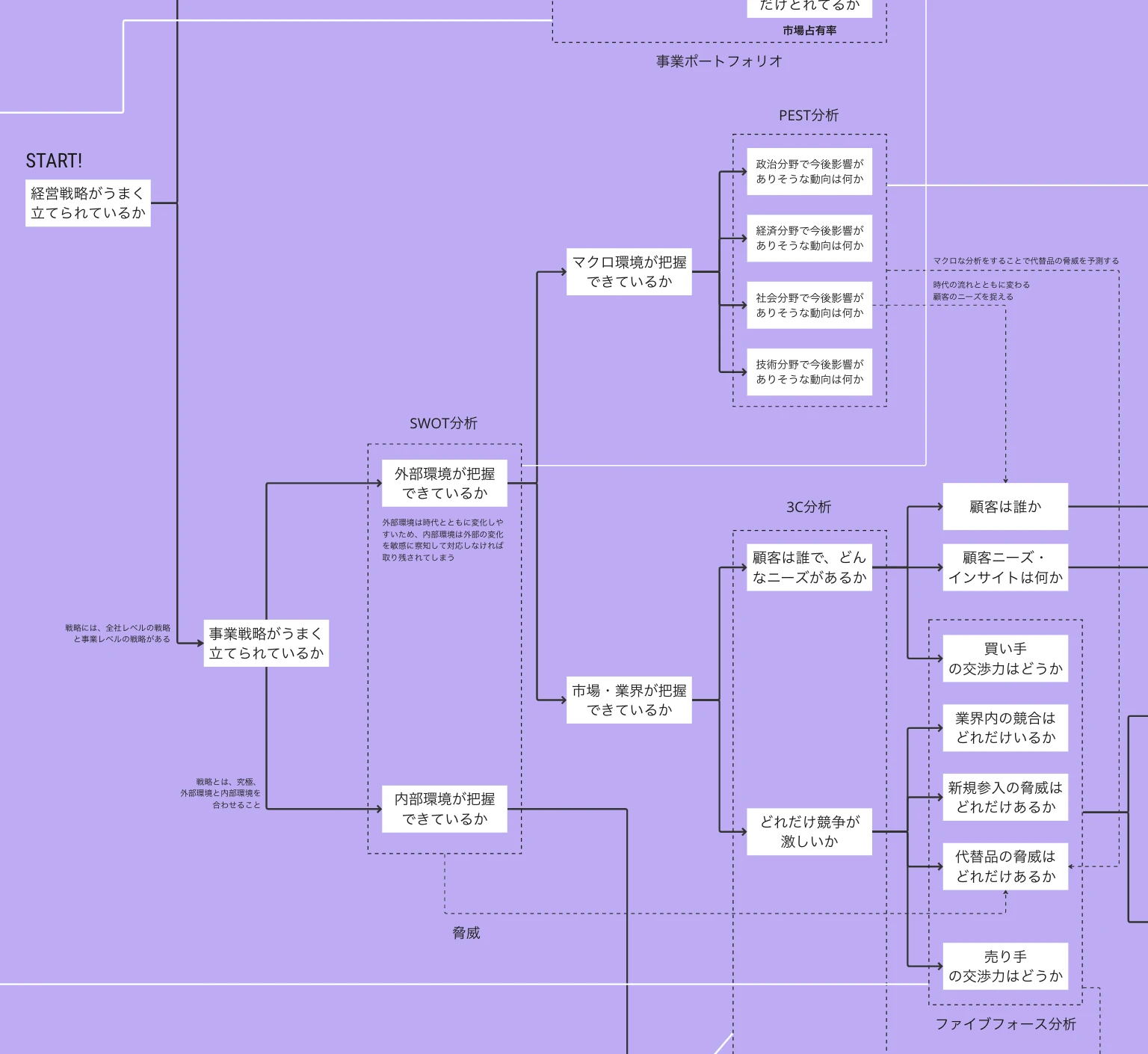
START is on the left side of the central area. Follow the questions from there to think through your strategy.
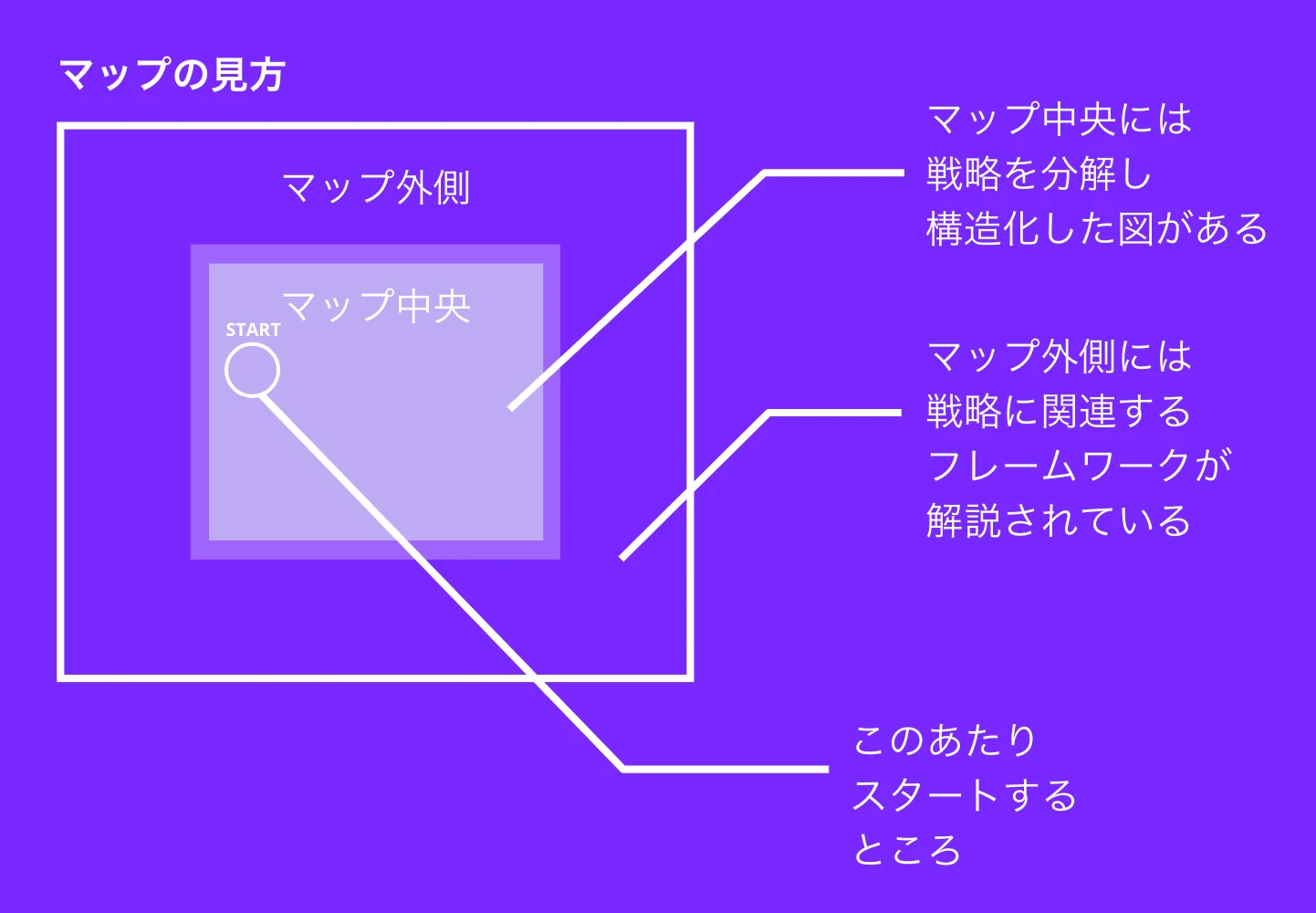
How to read it
Use each framework together with a question
The central area does not simply break strategy into parts. It breaks it into questions for thinking about strategy.
For example, the question "Is the business strategy well built?" requires understanding both the external and the internal environment, and each of those leads to further questions. If you cannot answer "Do we understand our external environment?", use the SWOT analysis framework.
Arrows connect the questions, but they do not only go one way. You think back and forth between them.
Who uses it
- corporate planning and design teams sharing a strategy across a department
It has been used in workshops at the design department of a major IT company and at a major electronics maker, to share across a team how strategy and frameworks connect.
Related projects
How the Strategy Map Was Born
Thank you for your interest in the Strategy Map. This map was born precisely out of a love of frameworks.
A “framework” is a template that condenses the wisdom of those who came before. Used well, it lets you quickly notice perspectives you had missed, and helps you output your thinking the way you intend.
However, frameworks are often introduced separately, and the more they are explained in isolation, the more there seemed to be a problem: even when you shouldn't really be using a given framework, you end up solving it like a simple fill-in-the-blank exercise—producing only a sense of accomplishment and spending fairly meaningless time.
So I thought, what if I gathered all the frameworks needed to build a strategy into a single map? That is the Strategy Map I created. Strategy is broken down element by element as a tree of questions, and the frameworks needed for each element are associated with it. I suspect this way of summarizing the whole picture may be a world first (if something similar exists, please let me know…).
Producing the Strategy Map took more than 30 hours, but that assumes I already knew the frameworks it contains and had accumulated materials I had diagrammed before; starting from zero knowledge, making this map would easily take twice as long. So for anyone who wants to roughly grasp the whole picture of strategy and frameworks, buying it is definitely worthwhile.
Currently, when people encounter a framework they don't understand, many look it up one by one, find the connections themselves, and try to apply it to strategy. By creating this map, we hoped ZUKAI could reduce that work time and let people spend more time on the more essential parts—ideas and proposals.
For the problem of so many people using frameworks without seeing the whole picture of strategy, we would be glad if this helps deepen understanding even a little and leads to an essential understanding and use of frameworks.
Contact
A problem you are stuck on, a project you are considering, a press inquiry. We also take inquiries that have not taken shape yet.
Talk to us