In September 2026, we ran a one-day training using the "Map of Accounting" for future department heads at YKK AP Inc. It was carried out through Diamond Human Resource, Inc.
Aim
The day was designed so that participants would grasp accounting as a structure by running a company as a team, not by memorizing it. No prior knowledge of accounting was assumed.
How the day went
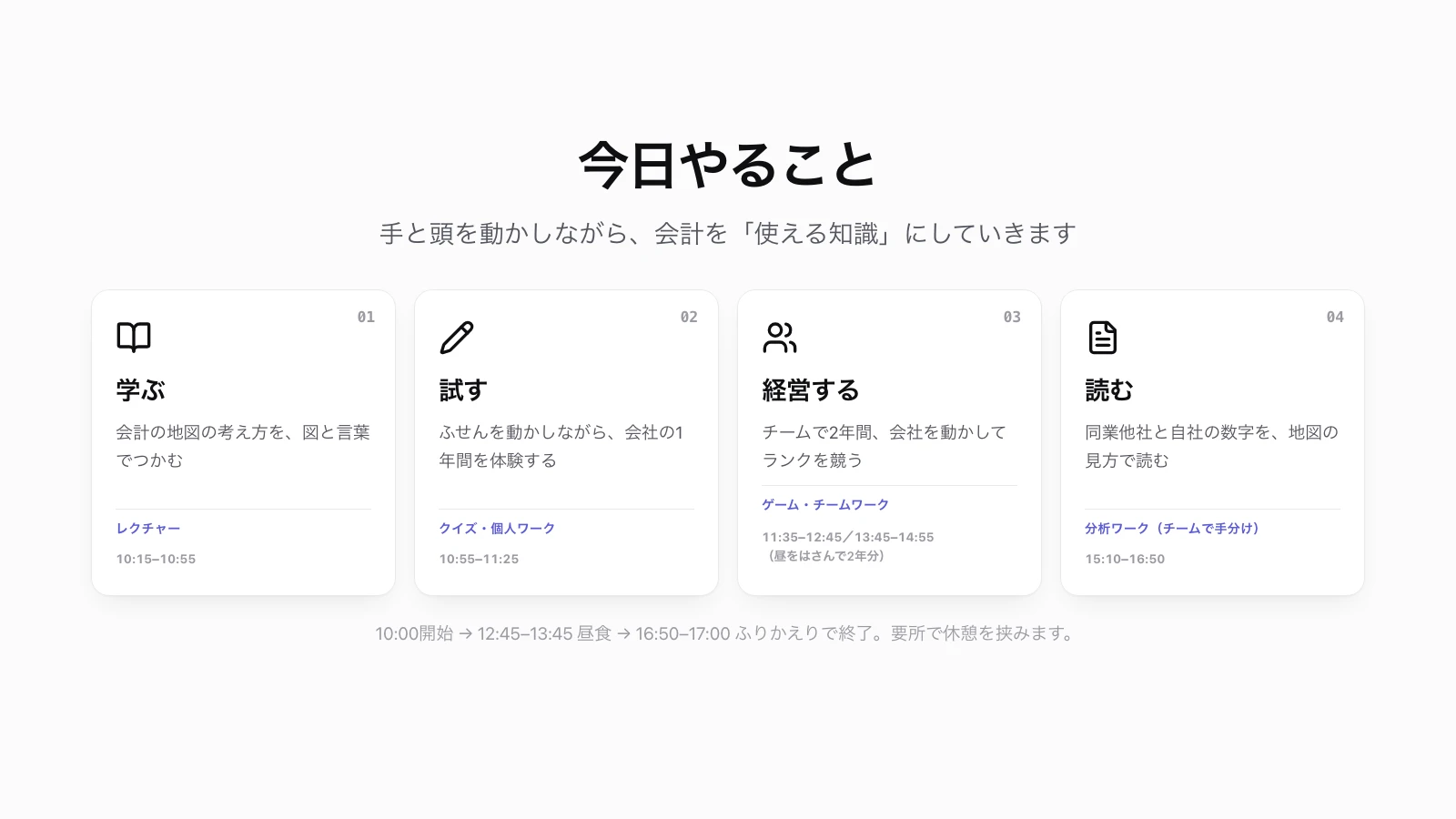
The day moved through four steps in order: learn, try, run a company, and read. The first three let participants grasp the structure of accounting with their hands, and the last used that view to read real numbers.
1. Lecture: how to read the "Map of Accounting"
We began with accounting as a shared language between people in different positions, and with how money flows through a company. We then went through how to read the "Map of Accounting" (five blocks, the left and right always matching, profit linking the income statement and the balance sheet) in the order of revenue, expenses, profit, assets and liabilities.
2. Individual work: the "Map of Accounting" quiz
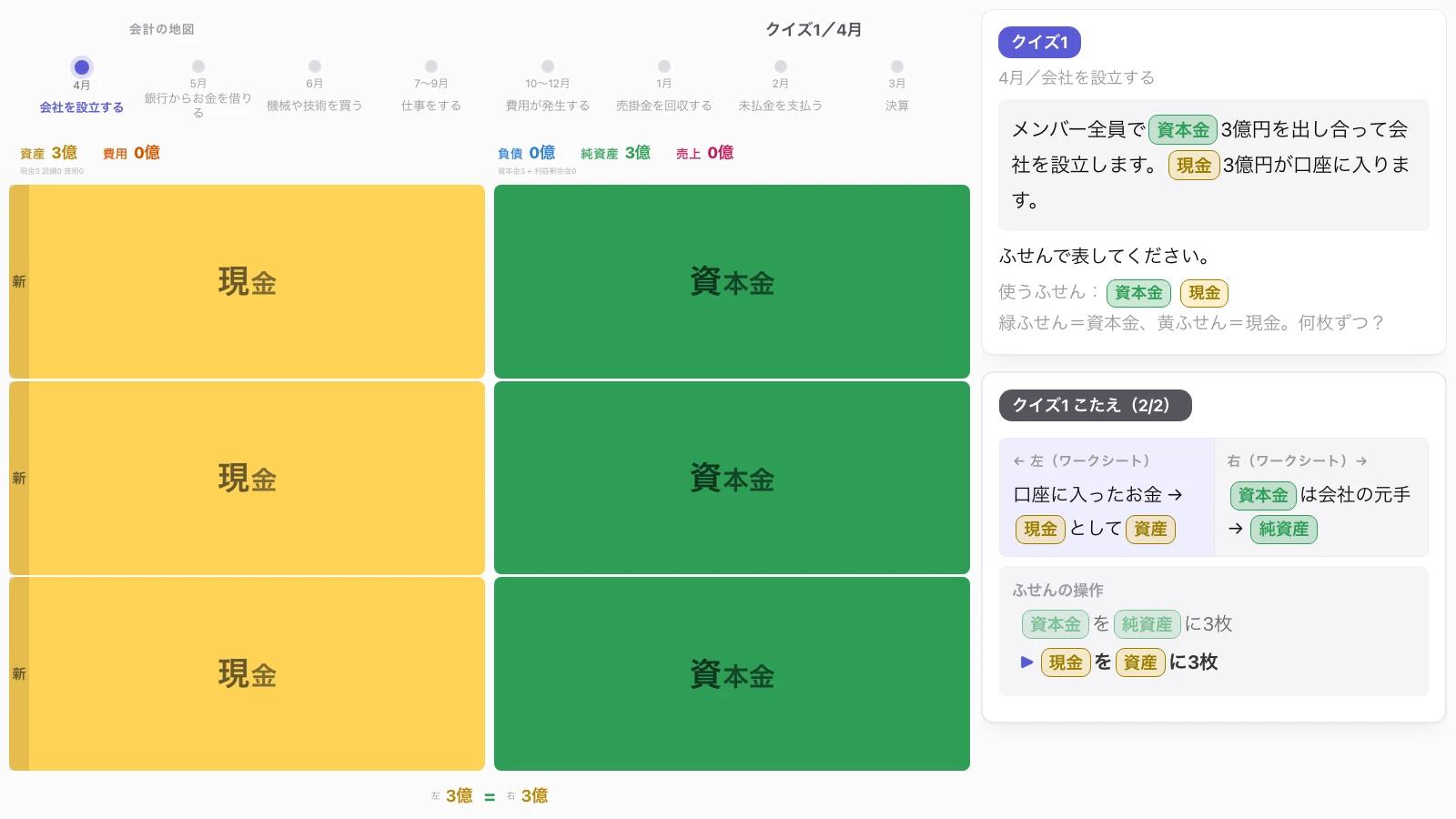
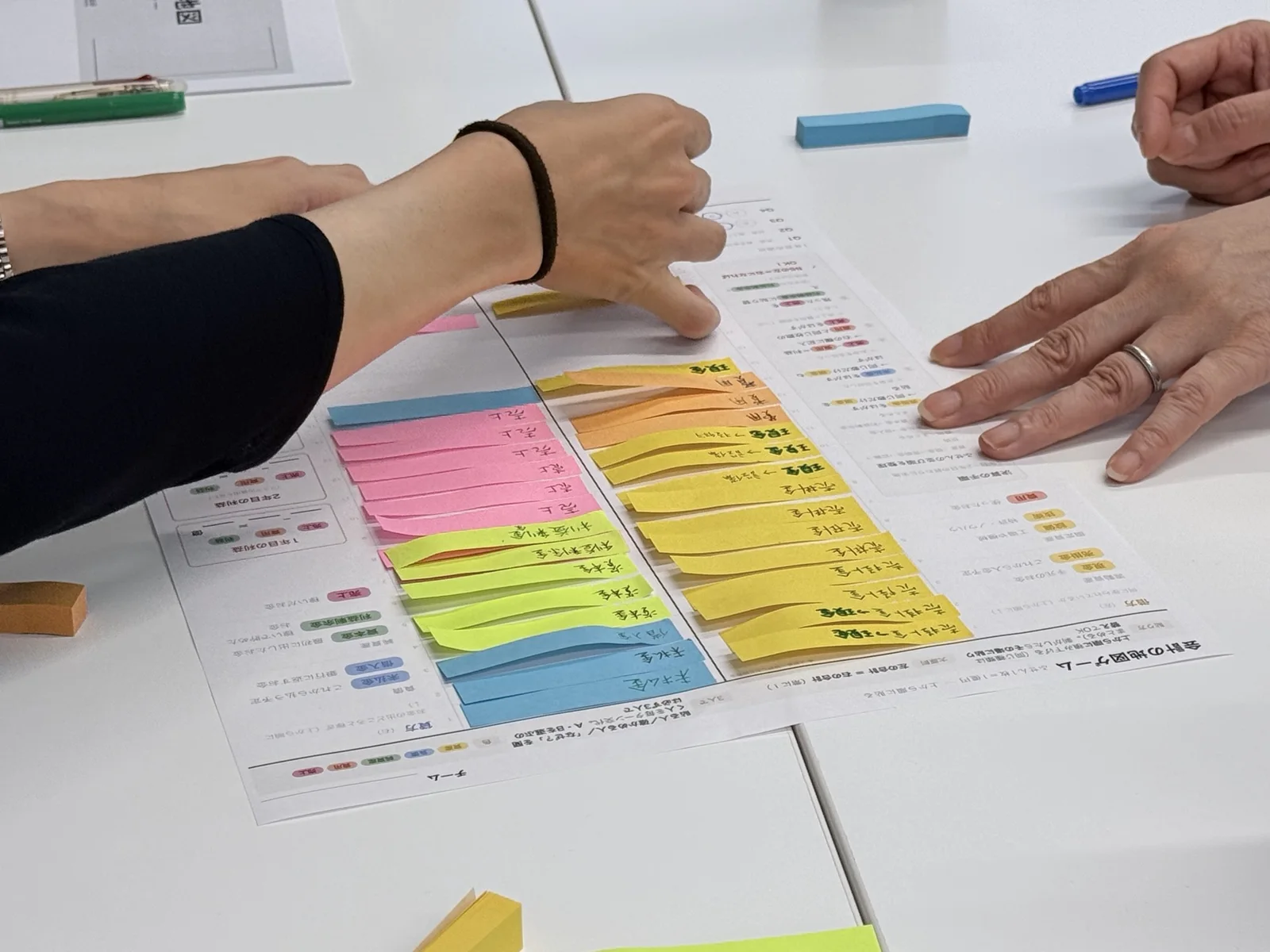
With one sticky note standing for 100 million yen, each participant followed eight steps from founding a company to closing its books, placing notes on a sheet. It is a way to check by hand where the map changes each time money moves.
The sticky notes come in five colors, for assets, liabilities, net assets, revenue and expenses. Assets and expenses go on the left, and liabilities, net assets and revenue on the right, stacked from the top.
The first question is founding the company. When the members put in 300 million yen together, three "capital" notes line up on the right and three "cash" notes on the left. This is where participants feel that the two sides always match.
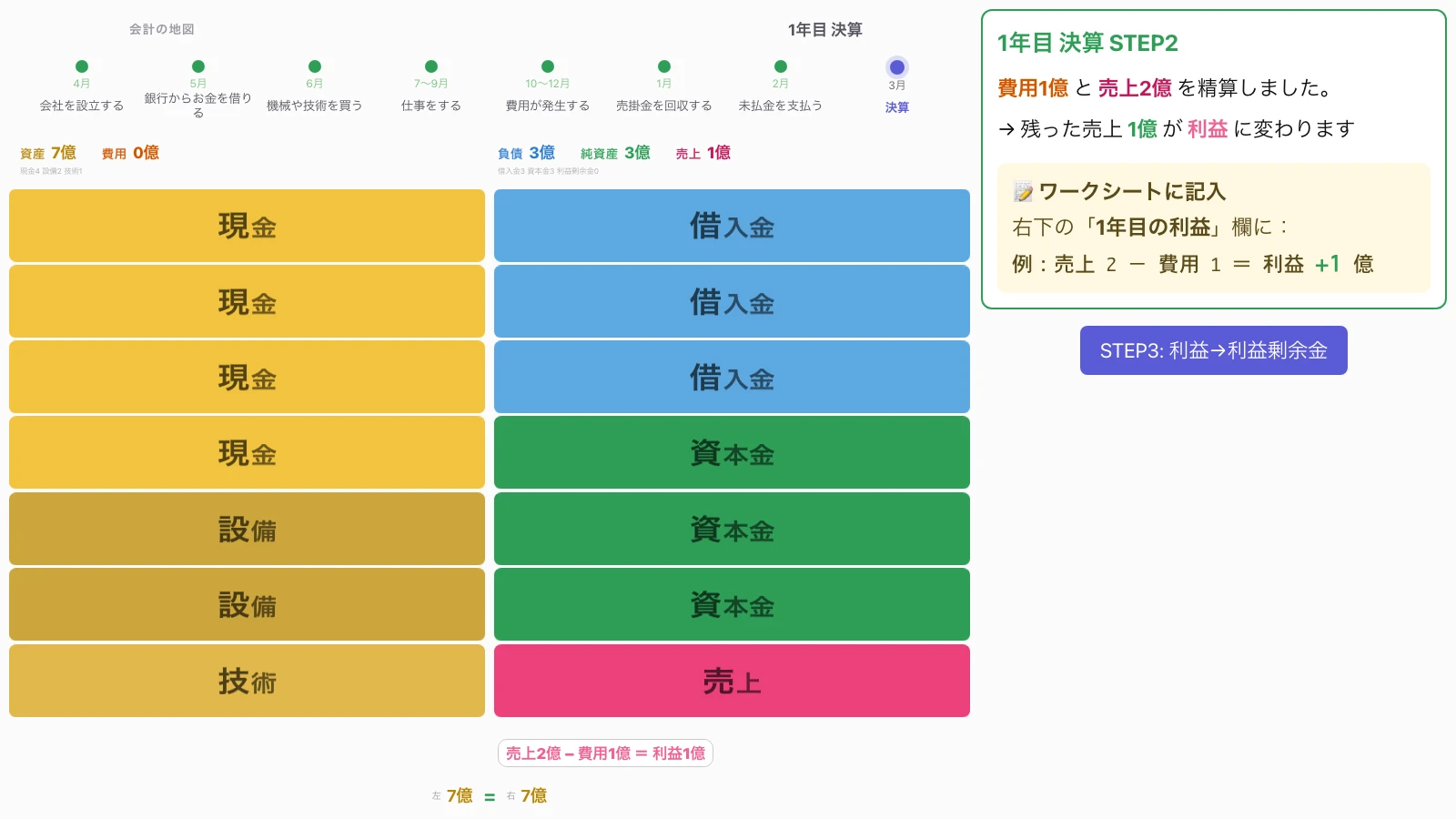
After the eight steps comes the closing of the books. Participants confirm that what remains after subtracting expenses from revenue becomes profit, and that the two sides of the map still match.
3. Team work: the "Map of Accounting" game
In three teams, participants ran a company for two years. Take more orders? Invest in equipment or in people? Enter a new market? Each team made its choices and closed the books, and the results were scored by net assets and equity ratio. The more aggressive choices a team made, the more "risk events" it had to draw.
4. Analysis: reading the company's own numbers
In the afternoon we used YKK AP's earnings presentation and integrated report. From the published numbers, participants calculated operating margin, year-on-year change and the five-year trend, and equity ratio, then discussed what lay behind them.
After the training
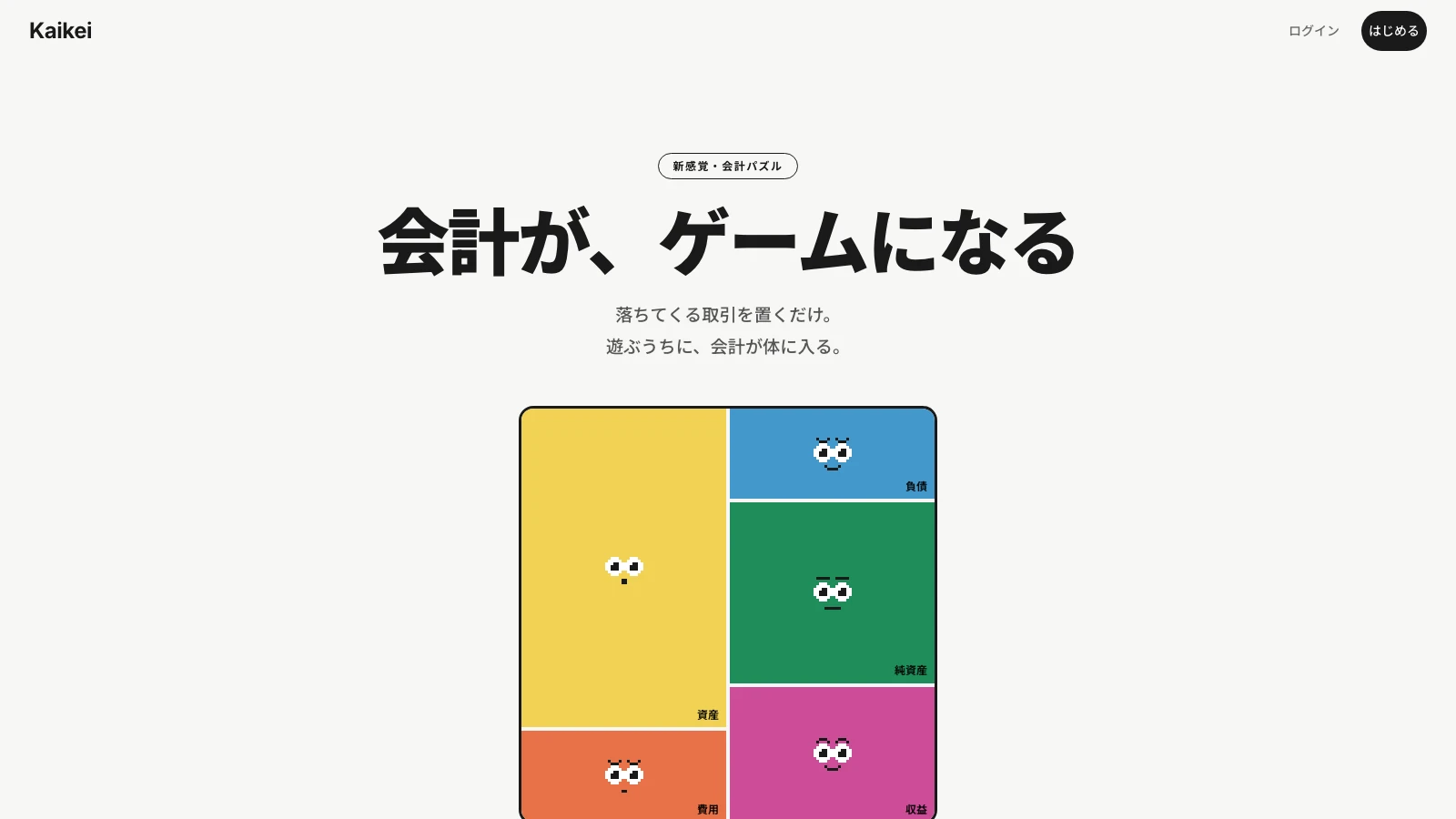
At the end, we introduced Kaikei, an app for continuing to practice alone. It lets you solve journal entries one at a time like a puzzle, so participants can repeat what they touched on in the training at their own pace.
Event details
- When: September 2026
- Venue: YKK AP Inc. head office (Chiyoda-ku, Tokyo)
- Participants: 9 future department heads (3 teams)
- Instructor: Tetsuro Kondoh, President and CEO, ZUKAI Inc.
- Carried out through Diamond Human Resource, Inc.
What the "Map of Accounting" is
A framework that conveys 15 accounting terms in a single diagram, from revenue, expenses and profit to assets, liabilities, net assets, cash flow, market capitalization, goodwill, PBR and ROE. It is published as The Map of Accounting (Diamond, Inc.).
Running this training
- Length: one day (10:00–17:00 this time)
- Size: nine people in three teams this time
- Prerequisite: no prior knowledge of accounting is needed
- Materials: A3 worksheets and sticky notes in five colors. ZUKAI prepares the slides and teaching materials
- The afternoon analysis work is built around the company's own published materials (results briefings and integrated reports)
For training enquiries, please use the contact page.