We held a three-hour workshop using the Strategy Map for the design division of a major IT company. Our CEO, Tetsuro Kondo, was the instructor, and two members of ZUKAI Inc. attended.
Background
In January 2025, we received an inquiry through our website. The client's design division works on co-creation with its customers and on supporting their businesses. Situations that call for knowledge of strategy and business, in addition to design, had been increasing, and the division wanted to collect methods it could use in practice.
What we made
- A set of five worksheets: choosing a competitive strategy, raising funds, allocating investment, facing risks, and the ending. Each team uses one set
- Lecture material: slides explaining the thinking behind the Strategy Map
- Strategy Map data: ahead of the workshop, we provided the source data of the Strategy Map as a Miro board
As the subject, we used an existing case comparing two flea market app companies. At first there was also a plan to tailor the case to the client, but given the preparation time we went ahead with the existing case.
How the game works
Participants become the management of a flea-market app company in a particular year. The company entered the market first, and a strong competitor has just appeared. Teams work through five sheets in order and find out where their choices lead.
- Choose a competitive strategy: the team decides whether to fight the competitor or not. The options are cost leadership, differentiation and focus
- Decide how much to raise: the more a team raises, the more points it has to invest, but the more often it will face risks later
- Allocate investment: the team distributes its points across five areas: advertising, hiring, expanding the customer base, cutting fees, and UX. All points must be used
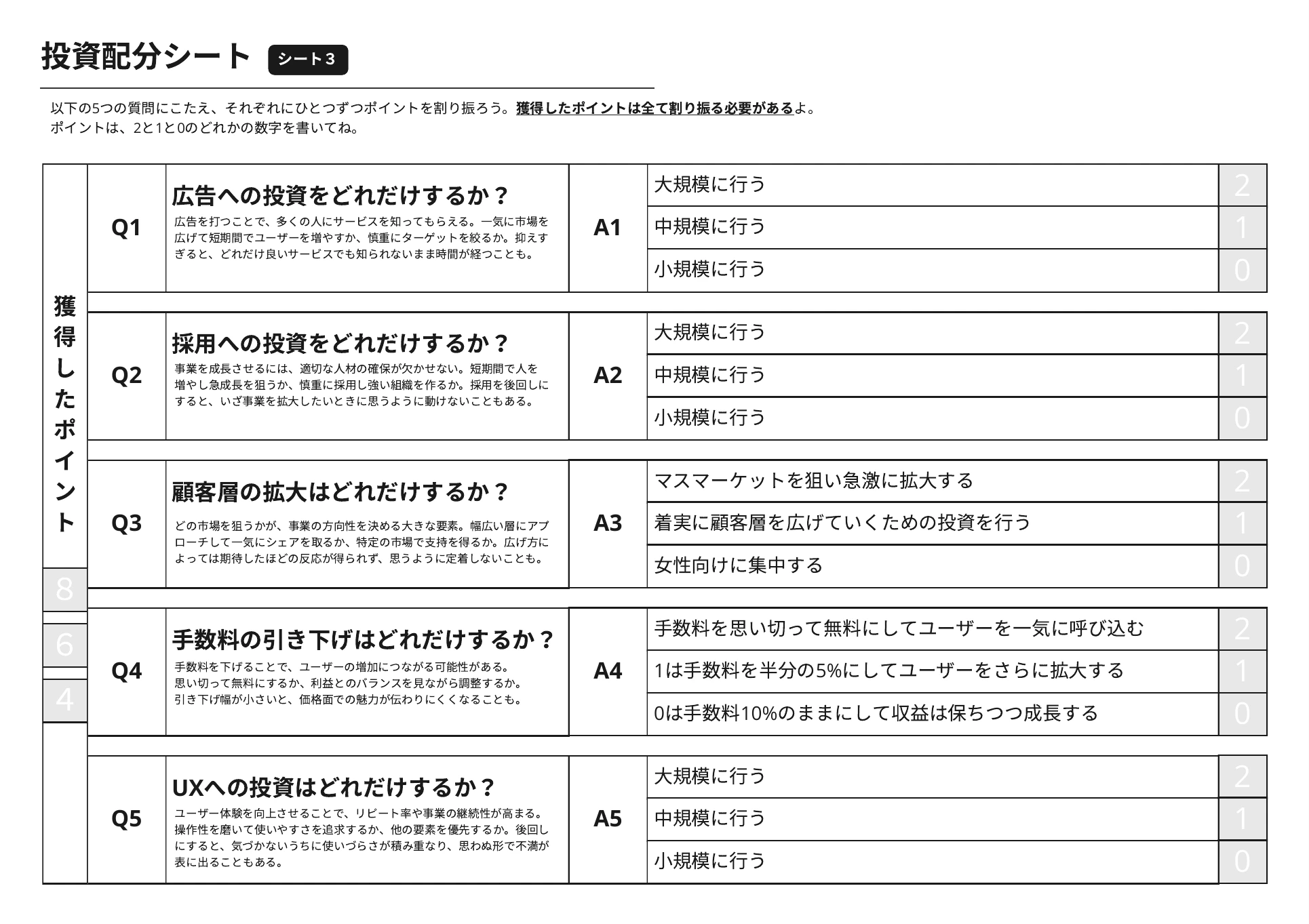
- Face risks: the team draws risks by ladder lottery. Another team draws the ladder lines. Depending on where the team invested, some risks can be avoided and others cannot
- Find out the ending: following the remaining points and the investments chosen leads to one of several endings, from standing at the top of the market to withdrawing from it
The fourth and fifth sheets are handed out in the second half of the session. Teams do not know what risks exist, or which choices lead to which ending, until they have finished choosing.
The same ending is rated differently depending on the strategy chosen at the start. An ending in which the company builds a firm position in a small market is exactly what a team that chose focus was aiming for, but for a team that set out to take the whole market it means ending up somewhere other than where its strategy pointed. The game is built so that teams look back not on whether the result was good or bad, but on whether their strategy, their funding and their investment allocation were connected.
How we worked
We met with the client in January and March. On the day, after the lecture, participants split into teams and worked through the worksheets in order from the first sheet. Sheets one to three were handed out at the start, and the fourth sheet on risks and the fifth sheet on the ending were handed out by the organizers in the second half. The final result changes depending on the strategy chosen, how funds are raised, and how investment is allocated.
Afterward we surveyed the participants and shared the results with the client. Many responses said they would like to try the exercise with a different subject.
Overview
- When: March 2025 (three hours)
- Format: in-person workshop
- ZUKAI Inc.'s role: planning the workshop, creating the worksheets and lecture material, teaching and running the day
- Deliverables: a set of five worksheets, lecture material, and Strategy Map data
- Published at: the workshop materials are not public